
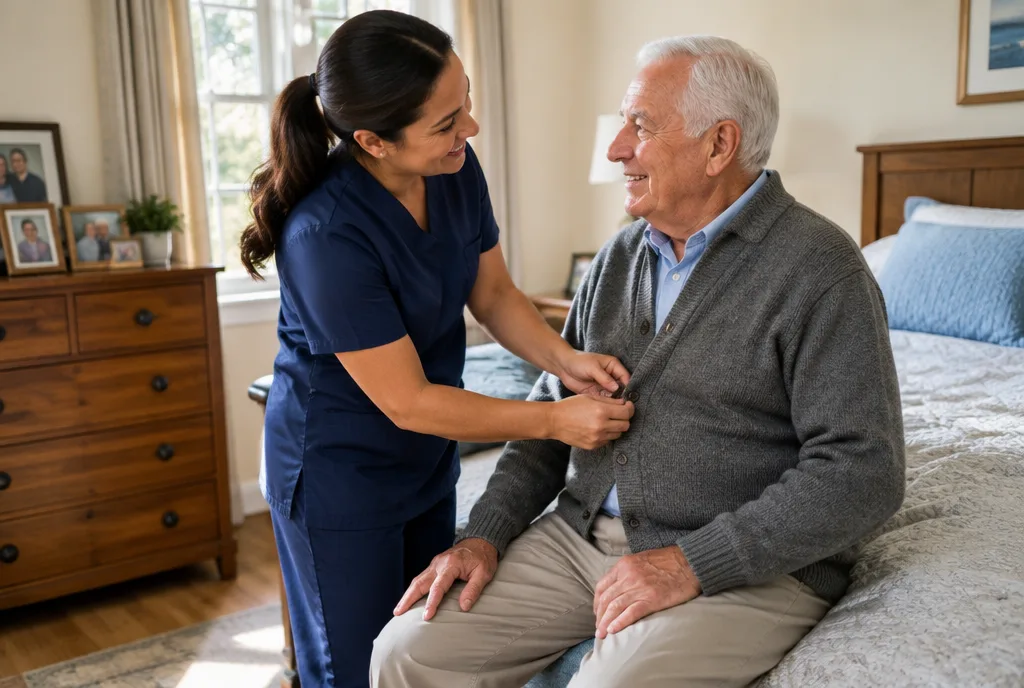
A home health aide helps a sick, disabled, or older person with everyday personal care at home. On a typical visit, the aide helps with bathing, dressing, grooming, and using the bathroom, helps the person move around safely, may check vital signs, prepares simple meals, does light housekeeping tied to the person’s care, and keeps them company. The aide works under the supervision of a nurse and reports any changes in the person’s health.
What a home health aide does not do is nursing work. Aides do not give injections, change sterile dressings, or make medical decisions. They are the hands-on helper of the care team, and often the person who sees your loved one most.
What is a home health aide?
A home health aide (HHA) is a trained caregiver who provides personal care in the client’s home. Most home health aides work for a home health agency or home care agency, and some work for hospice agencies. They serve older adults, people recovering from surgery or a hospital stay, people with chronic illnesses like heart failure or Parkinson’s, people with dementia, and people with disabilities.
What sets a home health aide apart from a general caregiver is training and supervision. An aide who works for a Medicare-certified agency must meet federal training rules and is supervised by a registered nurse or therapist. The aide follows a written plan of care that spells out which tasks to do on each visit.
Home health aide duties and responsibilities
The exact tasks depend on the plan of care, state rules, and the agency. Here is what a home health aide does on a typical day.
Personal care
- Bathing, showering, or giving a bed bath
- Help with dressing and undressing
- Grooming: hair care, shaving, oral care, and skin care
- Help using the toilet, bedpan, or commode, and incontinence care
- Basic nail care in some cases (see can home health aides cut nails for the limits)
Mobility and safety
- Help getting in and out of bed, a chair, or the shower
- Help walking, with or without a walker or cane
- Turning and repositioning a person who stays in bed to protect the skin
- Simple range-of-motion exercises that a therapist has taught
- Keeping the home environment safe: clear paths, good lighting, no loose rugs
Health monitoring
- Checking and recording temperature, pulse, breathing, and blood pressure, where the agency and state allow it
- Reminding the person to take medications (in most states, aides can remind but not give medicine)
- Watching for changes: new confusion, swelling, skin redness, poor appetite, pain, or falls
- Reporting those changes to the supervising nurse and writing notes after each visit
Household help and meals
- Planning and preparing meals, including special diets
- Helping with eating and drinking enough fluids
- Light housekeeping in the areas the person uses: changing bed linens, laundry, washing dishes, tidying the bathroom
- Some aides also run errands or go with the person to appointments, depending on the agency
Companionship
A good aide is also good company. They talk with your loved one, listen, play cards, go for a short walk, and notice when something seems off. For someone who lives alone, that daily contact can be as important as the physical help.
What a home health aide cannot do
Home health aides do not do tasks that require a nurse’s license. In general, they cannot give injections or IV medications, do sterile wound care, insert or manage catheters and feeding tubes, give medical advice, or change the plan of care on their own. The details vary by state. We cover this in full in what home health aides cannot do.

Home health aide vs. personal care aide vs. CNA
These titles overlap, and families often hear them used as if they meant the same thing. Here is the plain difference.
- Personal care aide (PCA) or caregiver. Helps with daily living, housekeeping, and companionship. There is no single federal training standard for personal care aides, so training depends on the state and the employer. They usually do not check vital signs or do health monitoring.
- Home health aide (HHA). Does everything a personal care aide does, plus basic health-related tasks like checking vital signs, under nurse supervision. Aides at Medicare-certified agencies must meet federal training and competency rules.
- Certified nursing assistant (CNA). Has a state certification and is listed on the state’s nurse aide registry. CNAs most often work in nursing homes and hospitals, but many also work in home health. A CNA can usually work as a home health aide, and many agencies prefer it.
So what is the difference between a caregiver and a home health aide? A caregiver can be anyone who helps, including family. A home health aide has formal training and works under a care plan with nurse oversight.
Home health aide training and certification
Federal rules for Medicare-certified home health agencies (42 CFR 484.80) set the minimum. An aide must complete a training program of at least 75 hours, including at least 16 hours of supervised practical training, and at least 16 hours of classroom training must come before that hands-on part. The aide must then pass a competency evaluation that covers topics like communication, observation and documentation, vital signs, infection control, personal hygiene, safe transfers, range of motion, and nutrition.
Once working, an aide needs at least 12 hours of in-service training every year. When the person is also getting skilled care, a nurse or therapist checks on the aide’s work at least every 14 days. When the person gets aide services only, a registered nurse makes an on-site visit at least every 60 days.
Many states require more than the federal minimum, and some require state certification or listing on a registry. Most entry-level jobs require a high school diploma or equivalent.
Live-in home health aide vs. hourly care
Most families start with hourly care: an aide comes for a few hours at set times, such as mornings for bathing and dressing. Agencies often have a minimum visit length.
A live-in home health aide stays in the home, usually for several days at a time, and has a private place to sleep. Live-in care makes sense when your loved one needs help at different times of the day and some support at night, but not constant awake care. The aide must get sleep and meal breaks, so live-in care is not the same as 24-hour awake care. If your loved one needs someone awake all night, you need two or three aides in shifts, which costs more.
Live-in care is usually billed at a daily rate. Ask the agency exactly what is included, how breaks are covered, and what happens if the aide is woken up often at night.
Home health aide cost
CareScout’s 2025 Cost of Care Survey puts the national median for a non-medical in-home caregiver, the category that now includes home health aides and homemakers, at $35 an hour. At 44 hours a week, that comes to about $80,080 a year. Rates in your area may be higher or lower.
The aide takes home much less than the agency charges. The U.S. Bureau of Labor Statistics reports a median wage of $17.21 an hour for home health and personal care aides, and expects jobs in the field to grow much faster than average. The difference covers the agency’s training, supervision, insurance, scheduling, and backup staff.
Who pays depends on the situation. Medicare covers a home health aide only part-time and only when your loved one is homebound and also needs skilled nursing or therapy. Medicaid, VA programs, and long-term care insurance may cover more. Read does Medicare cover a home health aide for the details.
How to hire a home health aide
- List the needs. Write down what help your loved one needs, at what times of day, and how many hours a week.
- Decide agency or private hire. An agency handles screening, training, payroll, taxes, and backup when the aide is sick. Hiring privately can cost less, but you become the employer.
- Check the agency. Ask if it is licensed in your state and, if you want Medicare to pay, whether it is Medicare-certified. You can compare certified agencies on Medicare’s Care Compare site.
- Ask good questions. How are aides trained and supervised? Are they background-checked? What happens if the aide cannot come? Our guides on finding a home care provider and interviewing home care or hospice providers have full question lists.
- Meet the aide first. A good personal fit matters. Your loved one should feel at ease with the person who helps them bathe.
- Stay involved. Read the visit notes, talk with the supervising nurse, and speak up early if something is not right.
Checklist: next steps
- Write down the daily tasks your loved one needs help with, and when.
- Sort them into personal care, household help, and nursing tasks.
- Decide on hourly care, live-in care, or shifts.
- Check what Medicare, Medicaid, VA benefits, or insurance will pay before you sign a contract.
- Call two or three agencies, compare rates and supervision, and meet the aide before the first visit.
- Plan breaks for yourself as the family caregiver. Our guide for family caregivers can help.