
An aging in place checklist helps you decide whether your parent, or you, can live safely at home for the long run, and what needs to change to make that possible. Go room by room and look for fall risks, hard-to-reach things, poor lighting, and places where help would be hard to get. Then check the parts that have nothing to do with the house: health, money, and who is around to help.
Most homes need a few small fixes, like grab bars, brighter bulbs, and fewer rugs, and one or two bigger ones, like a walk-in shower or a bedroom on the main floor. The checklist below walks you through all of it.
What does aging in place mean?
Aging in place means living in your own home and community as you get older, safely and independently, for as long as you can. It does not mean doing everything alone. For most older adults, it means a home that fits their body, a plan for help with daily tasks, and support from family, neighbors, or paid caregivers when needed.
Many older adults want to stay in the home they know, near their neighbors and routines. That is a reasonable goal, and planning early makes it far more likely to work. Falls are the biggest threat. The CDC reports that about one in four adults 65 and older falls each year, and many falls happen at home. So most of this checklist is about how to prevent falls.
When to start planning
The best time to age-proof a home is before anything goes wrong, often during a regular remodel or right after retirement. The second-best time is now. Needs change over time, so plan for future needs, not just today’s. A grab bar or a wider doorway is cheaper to add during other work than after a fall.
Entrance and outside
- At least one entrance with no steps, or with a ramp or sturdy railings on both sides.
- Good lighting at the door, ideally on a motion sensor.
- A covered spot to set down bags while unlocking the door.
- Lever door handles instead of knobs, and a lock that is easy to use with stiff hands, such as a keypad lock.
- House number large and visible from the street so emergency crews can find it.
- Walkways even, free of cracks, and cleared of snow, ice, and leaves.
Stairs and hallways
- Handrails on both sides of every stairway, running the full length.
- Light switches at the top and bottom of stairs.
- Contrasting tape or paint on step edges so each step is easy to see.
- Nothing stored on stairs, ever.
- Hallways at least 36 inches wide and free of clutter, cords, and furniture.
- Doorways at least 32 inches wide if your parent uses, or may one day use, wheelchairs or walkers. Swing-clear hinges can gain about an inch and a half of clear width without moving the frame.
- If stairs are already hard, plan for a stair lift or for moving the bedroom and a full bathroom to the main floor.
Bathroom
The bathroom is where many falls happen, so aging in place bathroom design deserves the most attention and often the biggest share of the budget.
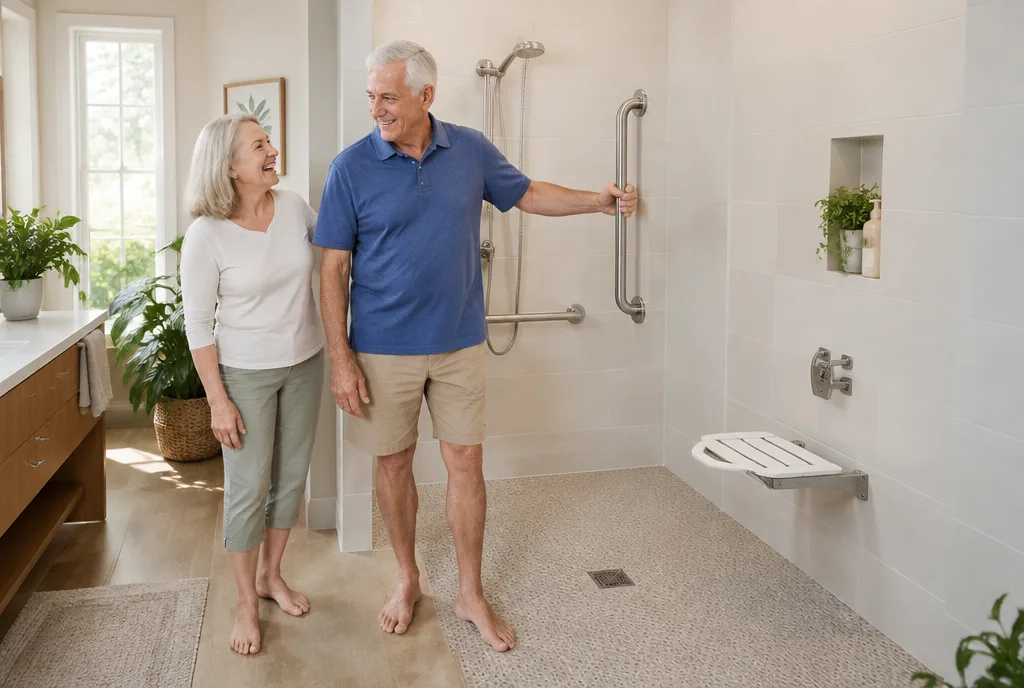
- Grab bars by the toilet and in the tub or shower, anchored into wall studs or with proper anchors. Towel bars are not grab bars.
- A walk-in or curbless shower instead of stepping over a tub wall.
- A shower chair or built-in bench, plus a handheld shower head.
- A comfort-height toilet, or a raised toilet seat with arms.
- Non-slip flooring, and non-slip mats or strips in the tub or shower.
- Lever faucets and an anti-scald valve, or a water heater set no higher than 120°F.
- A door that opens outward or a pocket door, so no one gets trapped if someone falls against it.
- A night light on the path from the bed to the toilet.
Kitchen
- Everyday dishes, pots, and food stored between hip and shoulder height.
- No step stools needed for daily tasks.
- Pull-out shelves or drawers in lower cabinets.
- A stove with front controls and automatic shut-off, or a kettle and appliances that turn off on their own.
- Bright light over the counter, sink, and stove.
- A working smoke detector and a fire extinguisher that is easy to reach.
- A place to sit while preparing food.

Bedroom
- Bed at a height where your parent’s feet are flat on the floor when sitting on the edge.
- A lamp and phone within reach of the bed.
- A clear path from the bed to the bathroom, lit at night.
- Clothes that are used every day stored at easy reach.
- A sturdy chair for sitting while dressing.
Lighting and flooring throughout
- Bright, even light in every room, with switches at each entrance.
- Night lights or motion-sensor lights in halls, bathrooms, and bedrooms.
- Throw rugs removed, or taped down firmly on all edges.
- Cords run along walls, not across walkways.
- No thresholds or level changes that catch a foot or a walker wheel.
- Low-pile carpet or smooth, non-slip hard flooring.
Technology and medical alert
- A medical alert system your parent will actually wear, ideally one with fall detection.
- A phone with large buttons, or a smartphone set up with emergency contacts.
- Smoke and carbon monoxide detectors that work, tested regularly.
- A pill organizer or automatic medication dispenser if doses are missed.
- A video doorbell or smart speaker if it helps your parent feel safer and stay in touch.
Health, money, and support checks
A safe house is only half of aging in place. Ask these questions too:
- Health: Can your parent manage medications, get in and out of bed and the shower, and cook simple meals? Have they had a fall, a hospital stay, or new memory problems?
- Help at home: Who helps with bathing, meals, errands, and rides? What happens if that person gets sick? Read what a home health aide does to see what paid help can cover.
- Money: Can the budget cover home repairs, modifications, and paid help if needs grow? See whether Medicare covers a home health aide before you count on it.
- Getting around: Can your parent still drive safely? If not, is there a bus, a ride service, or family to drive?
- Staying connected: Does your parent see people most days? Loneliness is a real health risk.
- Legal papers: Is there a durable power of attorney for finances, a health care power of attorney or proxy, and an advance directive or living will? These let someone act for your parent if they cannot. An elder law attorney can help.
- Caregiver load: If a family member is the main caregiver, is there a plan for breaks, such as respite care?
Who can help
An occupational therapist can do a home safety assessment. They watch how your parent moves through a normal day and recommend changes that fit their body, not a generic list. Ask your parent’s doctor for a referral. Medicare may cover occupational therapy when it is medically necessary, but a standalone home safety visit is not always covered. Some Medicare Advantage plans include one.
A Certified Aging-in-Place Specialist (CAPS) is a contractor, designer, or other professional trained through the National Association of Home Builders program. They know which changes work and how to build them. An occupational therapist and a CAPS contractor working together is a strong combination.
Your Area Agency on Aging can point you to home repair programs, safety checks, and in-home services. Call the Eldercare Locator at 1-800-677-1116 to find yours.
AARP’s free HomeFit Guide has more room-by-room ideas and works for renters as well as owners. You can find it at aarp.org/homefit.
What aging in place changes cost
Many fixes are cheap: bulbs, night lights, tape, and removing rugs. Bigger changes add up. Rough national ranges from the remodeling cost guide Fixr:
- Grab bars, installed: about $90 to $300 each
- Curbless shower: about $2,500 to $9,000
- Raised toilet: about $100 to $1,600
- Stair lift: about $4,000 to $8,000
- Ramp: about $1,400 to $3,000
- Widening a doorway: about $300 to $2,500
- Medical alert system: about $20 to $50 a month
- A typical aging in place remodel: about $3,000 to $15,000
Help with costs may come from Medicaid waiver programs in some states, local home repair programs, the VA’s HISA grant for eligible veterans (up to $6,800 for service-connected conditions, up to $2,000 for others), and USDA home repair grants of up to $10,000 for low-income homeowners 62 and older in rural areas.
Can a 90-year-old live alone?
Yes, many do. Age alone does not decide it. What matters is whether your parent can manage daily tasks, knows how to call for help, and has someone checking in often. A person of 90 with a safe home, a medical alert button, and daily contact may be safer than a person of 75 with memory loss living alone upstairs. Be honest about what you see, and ask your parent’s doctor if you are unsure.
Aging in place vs assisted living
Aging in place works well when the home can be made safe, care needs are manageable, and there is enough help. It stops working when those things fall apart. Signs that it may be time to look at assisted living or another setting:
- Repeated falls, even after changes to the home.
- Your parent needs help at night or around the clock.
- Memory loss leads to wandering, missed medications, or unsafe cooking.
- Paid help at home costs more than a move would, or the right help is not available.
- Your parent is isolated and lonely most of the time.
- The family caregiver is worn out. See when caring for a parent is too much.
Cost is part of the comparison. The CareScout Cost of Care Survey puts the national median for assisted living at about $6,200 a month and for a non-medical caregiver at home at about $35 an hour. A few hours of help a week at home usually costs less than assisted living. Full-time help at home often costs more. If your parent is still fairly independent but wants less upkeep, our guide to independent living explains another option.
Your aging in place checklist: next steps
- Walk through the home with this checklist and write down every problem.
- Fix the quick, cheap items this week: bulbs, night lights, rugs, cords, clutter.
- Ask your parent’s doctor about an occupational therapy home safety assessment.
- Get quotes from a CAPS contractor for the bathroom, stairs, and entrance.
- Call your Area Agency on Aging about repair programs and in-home help.
- Set up a medical alert system and emergency contacts.
- Talk as a family about who helps with what, and when to revisit the plan.
- Check the home again every year, or after any fall or hospital stay.